Forty-Third in Line: Seven Days of Reading Only What I Waited For
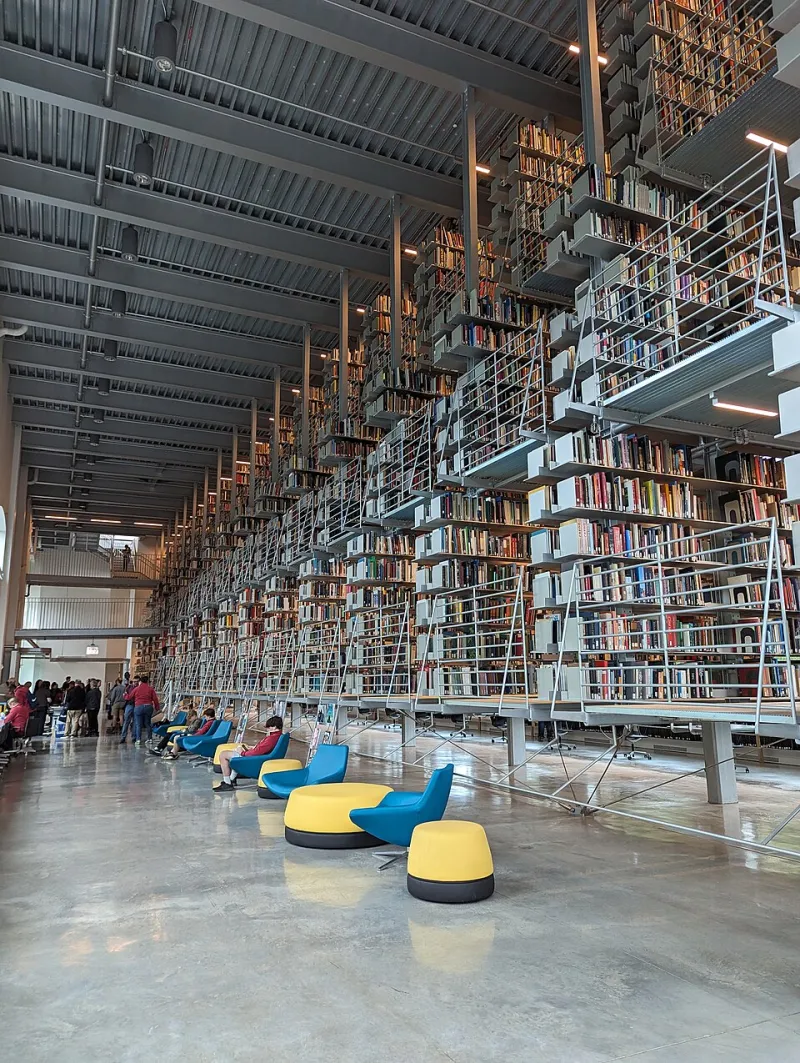
Photo: Cornellrockey, CC BY-SA 4.0, via Wikimedia Commons
My to-read pile has been the same height for three years. It is not a pile so much as a low, patient landmass on the corner of my desk, and I have learned to walk around it the way you walk around a cat. In early November I decided to stop pretending it was a plan and try something narrower: for seven days, I would read only books that arrived because I had waited for them.
No browsing. No buying. No pulling something off my own shelf because it looked good in the afternoon light. If it did not come through the holds queue, it did not get opened.
The Rule, and the Small Tyranny of the Queue
On a Sunday night I opened my library's app and placed eleven holds. Some were physical copies. A few were e-books through Libby, which is its own strange pleasure because the wait estimates are public and constantly shifting, like weather. The shortest said two weeks. The longest said six months, which is a polite way of saying maybe.
Then I closed the laptop and did nothing, which is the entire trick and also the hardest part.
The first arrival came on Tuesday. It was a book I had genuinely forgotten requesting, a slim nonfiction title about urban trees that I must have added at 11 p.m. during some earlier, more optimistic version of myself. I read it in two sittings, mostly because I had nothing else to read, and I noticed something almost immediately: I was paying attention in a way I usually don't. There was no next book waiting in the wings. No backup. Just this one, with a paper hold slip still tucked in the back.
Waiting Does the Editing for You
Here is the part I did not expect. Two of my eleven holds arrived as notifications saying the book was "available soon," which is library language for a two-day window before it moves on to the next person. In both cases I looked at the title and felt nothing. Not curiosity, not obligation, just a flat little shrug.
So I canceled them. Both. With one tap, from a bench outside a coffee shop.
That felt like getting away with something. Normally I only decide I don't want a book after I've bought it, which is a more expensive way to learn the same thing. The wait had done the editing for me, quietly, over the course of nine days, without ever asking me to sit down and make a decision. A queue is a filter you don't have to think about.
The Notification Rearranges Your Mood
By Thursday the experiment had developed a wrinkle. A hold I had been genuinely excited about landed on a day when I wanted something else entirely — something lighter, something I could read while stirring a pot of pasta.
The old me would have set it aside and picked up whatever I felt like. The new, self-imposed rule said: this is the book. Read the book.
So I did, and it was fine, and then around page sixty it stopped being fine and became good. That shift is not a coincidence. Mood is a terrible casting director. It only ever wants the same three actors. The queue, being indifferent to my mood, occasionally hands me something I would never have chosen on a Thursday night, and roughly one time in three, that turns out to be the thing I actually needed.
Two Weeks, No Renewals, and Other Small Gifts
Public libraries, at least the ones I've used in the US, tend to keep it simple: if nobody else is waiting, you can renew. If somebody is, you cannot. During my week, four of the books had a line behind them, which meant a hard deadline.
I have not read this efficiently since college. I read at the kitchen table instead of in bed, because the kitchen table is where I do things that have to get done. I read at lunch. I read standing up while the kettle boiled, which is not a recommended posture but is a very effective one.
The deadline did something else, too. It made finishing feel like relief rather than obligation. There is a particular satisfaction in handing a book back to a librarian knowing that someone else is waiting for it, that the object is moving through a system rather than fossilizing on my desk. My to-read pile is, at heart, a warehouse of good intentions. The hold shelf is a relay.
What I Abandoned
Two books got dropped mid-read. One was a novel I admired more than I enjoyed, which is a distinction that took me thirty-something years to learn. The other was a memoir that was perfectly good and simply not for me.
Here is the thing about abandoning a library book: it costs nothing. No sunk cost, no guilt spiral about the money, no bargaining with yourself about finishing because you paid for it. You close it, you put it in the bag, you return it. The transaction is complete. I have abandoned maybe four books in my entire adult life that I paid for, and I can still name them. The library ones I forget by the following Tuesday, which is exactly right.
A Short Protocol, If You Want to Try It
- Place more holds than you think you need. The queue is a filter; give it material to filter.
- Read in order of arrival. No skipping ahead to the one you're excited about.
- When the "available soon" notice comes, look honestly at the title. If you feel nothing, cancel it. That is not failure; that is the system working.
- Expect the arrival to be inconvenient. Read it anyway. At least once.
- Return things on time. Somebody is behind you in line.
The Pile Looks the Same, Which Is the Point
At the end of the week my desk looked almost identical. Same low landmass, a couple of spines swapped out. But the composition had changed. The books I'd read were ones I'd chosen weeks or months ago, in a calmer moment, and then been forced to honor. That turns out to be a better editor than the version of me standing in a bookstore on a Saturday, holding three things I don't need.
I'm keeping the rule for another month. Not as a discipline project, and definitely not as a productivity hack. More as a small agreement with my future self: I'll put the book in the queue, and I'll trust the queue to bring it back at the right time, even if the right time is a Tuesday I wasn't expecting.