Half Now, Half Later: The Movie Intermission You Have to Build Yourself
Somewhere around the fifty-minute mark, it happens. The score swells, a character walks into a hallway, and your hand drifts toward the remote — not to skip ahead, not to bail, just to stop. Most of us swat that impulse away like a mosquito. Finishing the movie is the point. Stopping is what you do when a film has lost you.
But that instinct is worth a second look. What if the pause was the plan all along?
The difference between a break and a bailout
Let's get the obvious objection out of the way. Pausing a movie and abandoning a movie are two different acts that happen to use the same button. The abandon is open-ended: the tab stays open for three weeks, the thumbnail loses its pull, and eventually the streaming service quietly files it under Continue Watching, where it joins eleven other ghosts.
An intermission is a scheduled return. You stop, you leave, you come back. The film is not on hold so much as it is between things.
This is not a new idea, just a neglected one. Roadshow engagements of the 1950s and '60s built the break into the ticket — moviegoers in US cities bought a reserved seat, watched an overture, sat through a printed intermission card, and came back for a second half with an actual orchestra warming up again. Lengthy releases still flirt with the form; "The Hateful Eight" toured in a roadshow version with an intermission built in, complete with a program. At home, we've had the technology for twenty years and almost none of the ceremony.
Pick the seam, not the clock
A break at 60:00 exactly is a break in the middle of a sentence. The trick is finding the film's own seam — the place where it was already taking a breath.
A few reliable markers:
- A scene change with a new location. Someone gets in a car, a plane lands, a title card announces a season.
- A time jump. If the story is about to leap forward, let it leap while you're in the kitchen.
- The end of a set piece. The chase ends, the party disperses, the song finishes.
- A question posed and not yet answered. This is the good one. You want to leave on curiosity, not confusion.
What you don't want is a cut mid-conversation, a reveal that lands while you're up refilling a glass, or anything in the last twenty minutes. The final act is a slope, and slopes are hard to re-enter.
One practical note: streaming menus are hostile to this. Thumbnails and episode previews love to spoil what's coming. If your setup allows it, turn previews off, or pause with the screen dimmed so you're not staring at a frame from forty minutes ahead.
The eleven minutes are the whole point
An intermission that lasts ninety seconds is not an intermission. It's a buffer. The break needs to be long enough that your brain changes rooms.
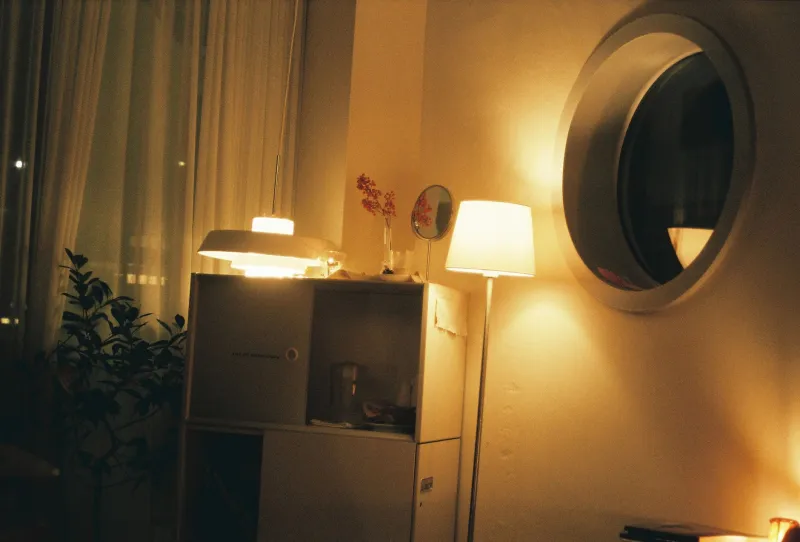
Here is roughly what works in our house: lights up to about half — enough to move safely, not enough to break the spell. A drink with ice in it, because the sound of ice is inexplicably part of the ritual. A snack on a plate rather than eaten from the bag, which is a small dignity the room deserves.
And then the hard rule: no new screens. No scrolling, no checking a score, no "wait, who is that actor." The phone is the one thing that can turn a fifteen-minute pause into a forty-minute one without anyone noticing. Stand up. Look out a window. Walk to the far end of the apartment and back. If there's a dog, this is its moment.
What you're doing, mechanically, is letting the first half settle. Films are built to be absorbed continuously, but absorption isn't the same as retention. A short gap gives the early scenes somewhere to land.
What the second half feels like
Here's the part that surprised me. Coming back after a real break, the movie gets a second opening. You re-enter with the alertness you had at minute five — noticing the framing, the color, the way a room has been dressed to look slightly worse than it did an hour ago.
It also gives you something to talk about. A pause is a natural place to say one sentence to whoever you're watching with, and one sentence is usually all a good movie night needs. Half the pleasure of watching at home is the low murmur of reaction, and an intermission gives that murmur a designated slot instead of letting it compete with dialogue.
The middle of a feature is where attention traditionally sags; that's just how pacing works. Move the sag into the hallway, and the movie keeps its momentum.
A few house rules
- One break only. Two pauses and you're watching a miniseries.
- Save it for the long ones. Anything past roughly two hours and fifteen minutes is fair game. A 95-minute comedy will not survive the interruption, and neither will a horror film — dread doesn't wait politely in the other room.
- Say the return time out loud. "Back at 9:20." Naming it is what separates an intermission from a slow drift toward bed.
- Don't research anything. No cast lists, no plot summaries, no Reddit thread from 2013. The whole value of the pause is that you stay inside the story's uncertainty.
There's a small theater being built in your living room every time you do this. The lights go halfway up, the ice clinks, the screen holds a frozen frame of a hallway. Then you sit back down, and the movie starts again — for the second time, but not from the beginning.
That's not giving up on a film. That's giving it a better seat.