Side One, Then Bed: A Weeknight Listening Experiment That Actually Ends
On a Tuesday after dinner, I did something suspiciously old-fashioned: I put on one side of a record, sat down, and did not touch my phone. When the needle lifted, I got up and went to bed. The whole thing took about 19 minutes. It felt less like a compromise than like the first weeknight listening session I had actually finished in months.
That small experiment turned into a habit. Not every night, and not with any solemn audiophile ritual. Just a simple rule: after dinner, choose one side of an album, play it, and stop. No shuffle. No queue. No “while I am up, I might as well play the rest.” One side, then bed.
The Problem With “Just Put Something On”
Streaming is wonderful at supplying music and terrible at supplying endings. You open an app, face a wall of options, and default to shuffle because choosing feels like a chore. Then the music keeps going. One song bleeds into another, then into a podcast trailer, then into a recommendation. An hour disappears, and you cannot quite remember what you heard.
A full album can have the same problem in a more respectable package. Some records are 45 minutes; some are 70. That is a perfectly good length for a drive or a long cooking project. On a weeknight, it can feel like a commitment you did not mean to make. You either abandon it halfway or stay up later than you planned.
The side solves both problems. It is long enough to feel like an event and short enough to end before you do.
A Short History of the Side Break
The side was not invented as a lifestyle concept. It was a physical necessity. Early records could hold only a few minutes per side, and as formats evolved, the roughly 20-minute side became a familiar container. Artists sequenced music around that break. They thought about how side one opened, how it closed, and what side two needed to do next.
Cassettes added the auto-reverse pause. CDs stretched listening time and made the full album the default. Streaming removed the pause almost entirely. None of this is a tragedy—convenience has real value—but it does mean we lost a useful built-in boundary. The side break was never just a technical limitation. It was a shape.
You do not need a turntable to borrow that shape. You only need to decide where the side ends.
The Rules I Landed On
After a few weeks, the experiment settled into a handful of practical rules.
- Pick the side before you sit down. Not the album, not the artist’s entire catalog. One side. If you are streaming, make a short playlist of four or five consecutive tracks and call it a side.
- Aim for 15 to 22 minutes. That is the sweet spot for a weeknight. Long enough to change the room; short enough that you are not negotiating with your own bedtime.
- Let the last song finish. This sounds obvious, but the temptation to queue “one more” is strong. The ending is the point. Treat the silence after the final note as part of the session.
- Put the phone in another room. Or at least face down and out of reach. The side is a container for attention, and attention is easier to give when the feed is not waiting.
- Do not make it a test. Some nights you will be distracted. Some records will not land. The habit is not a productivity system. It is a way to let a small piece of entertainment be small.
I also stopped doing it every night. Two or three times a week feels right. A ritual that happens constantly becomes a routine, and a routine becomes another thing to fail at. The side works best when it still feels slightly chosen.
Why It Does Not Feel Cut Short
A short story is not a failed novel. A 20-minute side is not a truncated album. It is a complete sequence with an opening, a turn, and a close. When you honor that sequence, the session feels intentional rather than abbreviated.
There is also a practical benefit: you actually listen. Without the option to skip or extend, you notice the bass line, the room in the recording, the way one track hands off to the next. You are not managing a queue. You are just in a chair.
And then it ends. You can read a few pages, rinse a mug, or go to bed. The evening has a shape instead of a tail.
What to Play
Start with something you already know. Familiarity makes the boundary easier, because you are not waiting for a big reveal. A used record bin is a good place to find cheap sides with clear beginnings. If you are streaming, look for albums with short track lists and a distinct first half. Avoid the 80-minute deluxe edition on a Tuesday.
The best pick is not necessarily your favorite album. It is the one whose side you can finish without checking the time.
Side One, Then Bed
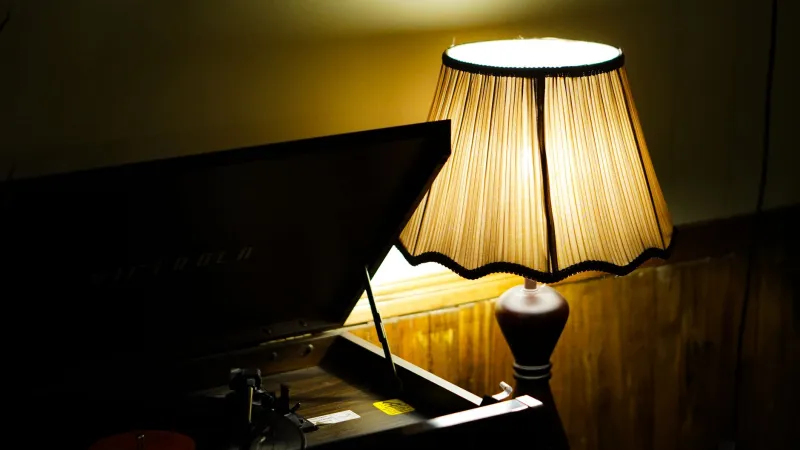
The experiment did not make me a vinyl purist. I still use shuffle in the car and let playlists run while I clean. But after dinner, I have started to prefer the older shape: one side, one lamp, one ending.
It is a small thing to build a weeknight around. That is exactly why it works.