After Dinner, One Lamp: A Softer Way to End the Day
At 7:30 on a weeknight, many apartments go through the same small ceremony. The plates are cleared. The dishwasher is loaded or argued about. Someone reaches for the wall switch and turns the living room into a runway. The ceiling fixture blazes. The room is bright, clean, and slightly clinical. It is also, somehow, less inviting than it was at lunch.
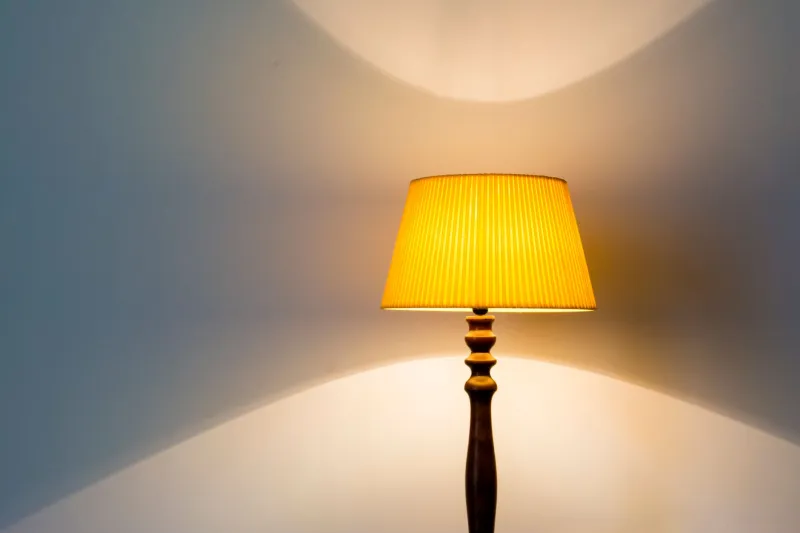
The fix is not a renovation. It is a habit: after dinner, turn off the overhead light and turn on one lamp. Not a lamp in every corner. One. A floor lamp by the sofa, a table lamp on a side table, a reading light near a chair. The point is to lower the room's volume without turning it into a cave.
I started doing this in a rental apartment with a builder-grade ceiling fixture and exactly one good lamp. It was not a design statement. It was an experiment in making the evening feel less like a continuation of the workday. After a week, the overhead light started to feel like a fluorescent office. The single lamp felt like a signal: the day is winding down.
The overhead light is a task light
Ceiling lights are designed to be useful. They fill a room, they help you find things, and they make it easy to clean. That is why they are so common in US apartments. They are also why they can feel harsh after dark. An overhead bulb throws light down from above, casting shadows under eyes and over furniture. It flattens the room into a working surface.
A lamp does something different. It creates a pool of light and leaves the edges softer. That contrast is the whole trick. The eye has somewhere to rest. The room feels smaller in a good way. You can read, talk, or watch TV without the feeling that someone has switched on the overhead for a home inspection.
This is not a new idea. Hotels have been doing it for decades. Good restaurants do it. The difference is that at home we often default to the brightest switch because it is the one by the door. The one-lamp evening is a way to choose the second switch.
The one-lamp setup
The setup is deliberately modest. Choose one lamp you already own, or one you can borrow from another room. A floor lamp with a wide shade works well in a living room. A table lamp with a linen or paper shade is good on a side table. Avoid anything that points directly into your eyes. The light should land on a wall, a book, or the floor, not on your face.
Place it where you actually sit. If you read in a chair, put the lamp behind or beside your shoulder. If you watch TV, put it off to the side so the screen is not competing with a bright bulb. If you talk with someone, put the lamp between you and the darkest corner. The goal is a small, warm circle of light, not a spotlight.
Bulb choice matters more than lamp style. Look for a warm white LED around 2700K. That is the color of old incandescent bulbs, and it reads as cozy rather than clinical. A dimmable bulb is useful if the lamp has a dimmer or if you plug it into a dimmer switch. If you are sensitive to brightness, aim for fewer lumens rather than more. A single lamp does not need to light the whole room; it needs to make the room feel lit.
Renters have a few easy advantages here. You do not need to rewire anything. A plug-in dimmer, a smart plug, or an outlet timer can turn the lamp into a small ritual. Adhesive cord clips keep cables tidy without nails. If the overhead fixture is the only light in the room, leave it off after dinner and let the lamp do the work. If the room is too dark, add a second small lamp on the other side, but keep it lower than eye level.
A weeklong trial
Do not buy a new lighting setup for this. Use what you have. For one week, make a simple rule: after dinner, the overhead light goes off and one lamp goes on. That is it. No new furniture, no rewiring, no mood board.
On the first night, the room may feel too dim. Give your eyes a few minutes. On the second night, you might notice that you are speaking a little more quietly. By the third night, the lamp may start to feel like a cue. This is when the evening begins. Reading feels less like a task. A conversation feels less like a meeting. Streaming a show feels less like staring at a screen in a fluorescent box.
If the room is still too dark for a specific task, use a small task light and turn it off when you are done. The point is not to ban overhead light. It is to stop using the brightest option by default. The kitchen can stay bright. The bathroom can stay bright. The living room after dinner can be softer.
What the single lamp changes
The one-lamp evening is not about aesthetics for their own sake. It is about transition. Most apartments do not have a hallway or a mudroom or a separate study. The same room has to be an office, a dining room, a movie theater, and a place to relax. Light is one of the few tools you have to mark the shift.
A single warm lamp says: this room is no longer for email. It is for a book, a friend, a low-stakes show. That is a small thing. But small things are often what make a rental feel like home. And unlike a new sofa, a lamp habit costs almost nothing to try.
If you only change one thing this week, change the switch you reach for after dinner. Leave the overhead off. Turn on one lamp. See what the room sounds like when it is quieter.