The Curb-Side Reading Room: A Week of Little Free Libraries
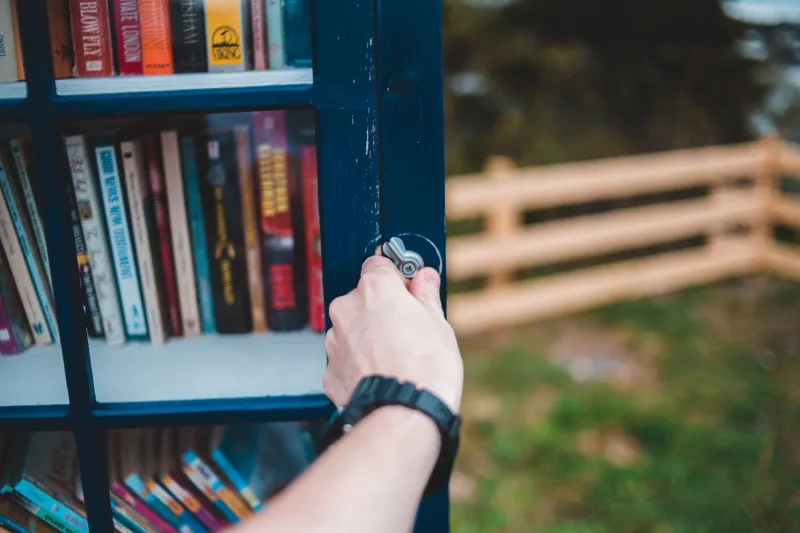
On a Tuesday morning in November, the box on the corner is already awake. It is a wooden cabinet the size of a microwave, mounted on a post beside a maple tree that has mostly given up. The little sign says Take a Book, Share a Book, and the door has a small brass latch that feels more ceremonial than secure. Inside: a paperback thriller with a cracked spine, a children’s book about a bear who cannot sleep, a cookbook with a butter stain on page 84, and a sticky note that says, simply, For whoever needs a laugh.
I spent a week visiting five Little Free Libraries within walking distance of my apartment. Not to clear them out or stock them up, but to read them the way you might read a neighborhood notice board. What I found was less like a lending system and more like a slow, low-stakes conversation. No one was moderating it. No one was asking me to join.
The Rules Are Mostly Weather and Trust
A Little Free Library has almost no infrastructure. There is no card, no due date, no late fee, no app. The charter sign is the entire terms of service. You open the door. You look. Maybe you take something. Maybe you leave something. Maybe you just close the door and keep walking.
That lack of obligation is the point. Most community spaces ask for something: attention, attendance, a purchase, a reply. This one asks for a stroll and a glance. On a chilly evening, that feels like a generous social contract. You can participate without performing.
The five boxes I visited had different personalities. One, outside a coffee shop, was jammed with glossy bestsellers and smelled faintly of espresso. One, in a residential cul-de-sac, held mostly children’s books and a single copy of a very serious history of the Philippines. One was practically a mini lending library for gardeners, with seed packets tucked into a plastic bag. One was almost empty. One was overfull, the door barely latched, as if the neighborhood had been meaning to sort it out for weeks.
What Gets Left Behind
The inventory is a mood ring. I found books that were clearly cleaned out from a home shelf: airport thrillers, diet books from another era, a memoir with a dog-eared bookmark still in place. I found advance reader copies, which always feel like small acts of smuggling. I found a cookbook with a handwritten recipe for cornbread on the inside cover, and a novel with a note that said, Read this on a train. You can too.
The donations tell you what people are ready to let go of. The takings tell you what people are ready to carry home. Over the week, the thrillers moved. So did the children’s books and anything with a practical cover—gardening, home repair, budgeting. A slim book of essays sat untouched for four days and then vanished. The cookbook stayed. The history of the Philippines stayed. The book about the bear who cannot sleep stayed until Thursday, when it did not.
What surprised me was how quickly the boxes became legible. A stack of mysteries meant someone had finished a series. A cluster of parenting books meant a household was moving on. A lone copy of a classic with a cracked spine meant someone had been ambitious at a yard sale. You could read the block by its castoffs, not in a nosy way, but in the way you notice which houses put out pumpkins and which ones never take down their holiday lights.
The Notes Inside the Covers
The handwritten notes are the best part. They are not reviews. They are evidence. One paperback had a sentence underlined on page 42 and a margin note that said, This is the whole book. Another had a grocery receipt from a town two hours away. A children’s book had a sticker on the inside cover: From the shelf of Ellie, age 7. Ellie is probably not seven anymore. The book is still here.
I left a note of my own in a paperback I had finished the week before. Nothing profound. Just: Good for a rainy afternoon. I do not know if anyone took it. I am not sure I want to know. The pleasure was in adding a sentence to a conversation I would never hear.
That is the quiet genius of the format. A Little Free Library is not a group chat with notifications. It is a group chat with a doorknob. You check in when you walk past. You see what is new. You leave something behind. Then you go home.
Why It Works
We talk a lot about third places—cafes, parks, barbershops—as if community requires a seat and a purchase. A curb-side book box is even lower maintenance. It is a public square scaled to a paperback. It does not need a staff. It does not need a schedule. It only needs a few people who are willing to keep the door closed and the shelf roughly honest.
And because it asks so little, it can include more people. The parent pushing a stroller at 7:45 a.m. The retiree walking the dog. The kid on a bike who has been told not to talk to strangers but can absolutely open a box. The person who is new to the neighborhood and not ready to knock on a door. Everyone gets the same view: a small wooden shelf, a few spines, a note in the margin.
A Field Guide for Your Own Walk
If you want to visit one this week, keep it simple. Bring one book you are genuinely done with, not a box of castoffs you are trying to offload. Open the door gently. Look at the spines, not just the covers. If something moves you, take it. If you take it, try to bring it back or pass it on. Do not treat the box as a recycling bin. Do not fix the whole neighborhood in one afternoon.
And if you see a handwritten note inside a cover, read it. It is not metadata. It is the smallest kind of public diary, left by someone who thought a stranger might like the same page. In November, with the light leaving early, that feels like enough.